Le Chariot, Arcanum VII: The Weight of Appearances
In brief
- Le Chariot reveals a central tension: the person prioritizes the image over the being, and this pride prevents being themselves.
- On the upright axis, the visible success, social and professional, brings joy, but it remains fragile and artificial because it is built on appearance.
- On the reversed axis, the failure in projects and the professional difficulties are felt more severely than they are, yet the painful passage does not necessarily have negative consequences.
- The card distinguishes a successful life from a fulfilled one: the first is artificial and short-lived, the second is authentic and durable, and the pride of Le Chariot keeps you from the second.
Contents
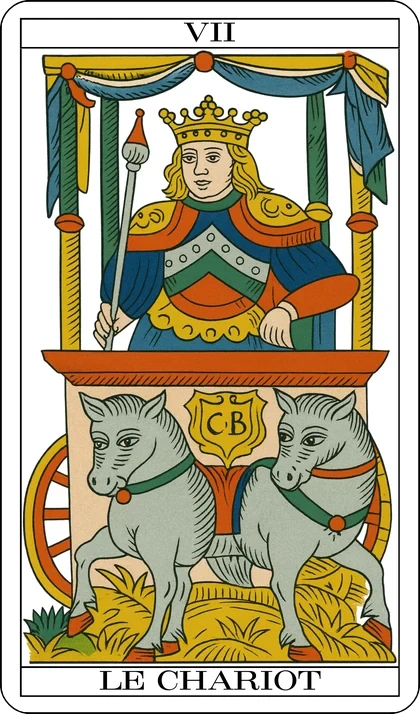
Le Chariot shows a crowned figure standing in a canopied chariot, scepter in hand, with two horses harnessed side by side. This major arcanum signifies visible success and the pride that can accompany it, distinguishing between what you achieve in the eyes of others and what you actually become. Upright, it points to triumph and social recognition; reversed, it signifies its own meaning of reversals and difficulties felt more deeply than their real weight.
| Numeral | Card |
|---|---|
| no numeral | The Fool |
| I | The Juggler |
| II | The Popess |
| III | The Empress |
| IIII | The Emperor |
| V | The Pope |
| VI | The Lover |
| VII | The Chariot |
| VIII | Justice |
| IX | The Hermit |
| X | The Wheel of Fortune |
| XI | Strength |
| XII | The Hanged Man |
| XIII | The Nameless Arcanum |
| XIIII | Temperance |
| XV | The Devil |
| XVI | The House of God |
| XVII | The Star |
| XVIII | The Moon |
| XIX | The Sun |
| XX | Judgement |
| XXI | The World |
Justice is VIII and Strength XI, the reverse of the Rider-Waite. Card XIII bears no name.
The Card
A crowned figure stands inside a chariot covered by a canopy supported by four columns. The figure holds a scepter in one hand. Two horses are harnessed side by side at the front of the chariot. On the body of the chariot, a shield bears two letters. That is all the card shows: no landscape, no additional figures, no decorative elements beyond these. The numeral VII appears on the card, printed in its additive form, marking this as the seventh of the twenty-two major arcana.
What the Card Signifies
Le Chariot signifies a fundamental tension between appearance and being. The crowned figure, the scepter, the canopied chariot: everything on this card points to image, to what is shown, to what is presented to the world. The card signifies a tendency to privilege the surface over the substance, to overvalue how things look rather than what they are.
This arcanum signifies the pride that prevents being oneself. The crown and the scepter are not merely ornaments; they signify a posture, a way of holding oneself that can become a cage. When image takes precedence, the person behind the image recedes. Le Chariot points to that specific risk: the risk of becoming the role, the title, the appearance, and losing the self in the process.
The card also establishes a sharp distinction between success and realization. Success, as Le Chariot shows it, is fragile and artificial: it depends on the gaze of others, on recognition, on the maintenance of an image. Realization is different. Realization is authentic and durable: it does not depend on being seen, it does not require a crown, it does not need a chariot. Le Chariot signifies the gap between these two, and the cost of confusing them.
Upright
Upright, Le Chariot points to social success. This is the card of recognition, of being seen and celebrated, of achieving what others can witness. Professional success follows closely: the card signifies advancement, promotion, the kind of achievement that comes with a title or a visible position.
The card also signifies an evolution that fills with joy. This is not merely success on paper; it is the satisfaction that comes from seeing one’s efforts acknowledged, from feeling that one’s work has borne fruit. Satisfaction in various activities rounds out the upright meaning: the card points to a period where multiple endeavors bring fulfillment, where the person feels effective and valued. The word that sums up this orientation is triumph.
Reversed
Reversed, Le Chariot signifies its own meaning, distinct from the upright. It points to failure in pursued projects. This is not the absence of success; it is the specific experience of seeing projects collapse, of watching efforts come to nothing, of facing the gap between what was attempted and what was achieved.
The card also signifies professional difficulties felt more severely than they actually are. This is a crucial nuance: the difficulties are real, but their weight is amplified by perception. The person experiences them as crushing, as defining, when in fact their objective importance is smaller than the pain they cause. Le Chariot reversed points to a difficult passage, lived painfully, but whose consequences are not necessarily negative. The passage hurts, but what comes after may not be worse; it may simply be different.
What Nuances This Reading
The meaning of Le Chariot depends on its position in a spread: a card placed in a position of past, present, or future does not carry the same weight. The cards that surround it also modulate its sense: Le Chariot next to a card of introspection does not have the same meaning as Le Chariot next to a card of action. The question asked shapes everything: the same card answers differently to a question about work, about love, or about identity. None of this can be known from the card alone.
Frequently Asked Questions
What is the difference between success and realization in Le Chariot?
Success, as Le Chariot shows it, depends on external recognition: it is fragile and artificial. Realization is internal and durable: it does not require being seen. The card points to the gap between the two and the risk of confusing them.
Does Le Chariot always indicate a positive outcome?
No. Upright, it points to triumph and visible success. Reversed, it signifies its own meaning: failure in pursued projects, difficulties felt more severely than their real weight, a painful passage whose consequences are not necessarily negative.
What does the shield with two letters mean on Le Chariot?
The card shows a shield bearing two letters on the body of the chariot. The letters are part of the card’s visual language, but their specific meaning is not fixed: they belong to the image itself, not to an external code.
How should I read Le Chariot when it appears reversed?
Read it as its own meaning, not as the upright blocked or negated. Reversed, Le Chariot signifies its own meaning: projects that fail, professional difficulties amplified by perception, a difficult passage whose outcome is not necessarily worse than what came before.