La Justice: The Unforgiving Ledger of the Marseille Tarot
In brief
- « La Justice » embodies the law of cause and effect: every action you take sets a chain in motion, and no energy is ever lost, whether for good or for ill.
- Upright, you can expect favorable rulings and official recognition: your efforts are weighed fairly, and you feel heard in legal or administrative matters.
- Reversed, you face unfair verdicts and bureaucratic dead ends: the scales tip against you, and the taste of imbalance is bitter.
- The central tension is between cosmic equilibrium and human fallibility: the law of cause and effect never fails, but the institutions that apply it can.
- Reversed also points to the nervous toll of injustice: anxiety, sleeplessness, and inner turmoil when you feel unheard.
Contents
La Justice, arcanum VIII of the Marseille Tarot, signifies an impersonal order of cause and effect before which every act is placed. Upright, it points to equity obtained: favorable rulings, official recognition, balance. Reversed, it carries its own meaning: iniquity suffered, excess, and disturbance.
| Numeral | Card |
|---|---|
| no numeral | The Fool |
| I | The Juggler |
| II | The Popess |
| III | The Empress |
| IIII | The Emperor |
| V | The Pope |
| VI | The Lover |
| VII | The Chariot |
| VIII | Justice |
| IX | The Hermit |
| X | The Wheel of Fortune |
| XI | Strength |
| XII | The Hanged Man |
| XIII | The Nameless Arcanum |
| XIIII | Temperance |
| XV | The Devil |
| XVI | The House of God |
| XVII | The Star |
| XVIII | The Moon |
| XIX | The Sun |
| XX | Judgement |
| XXI | The World |
Justice is VIII and Strength XI, the reverse of the Rider-Waite. Card XIII bears no name.
La planche
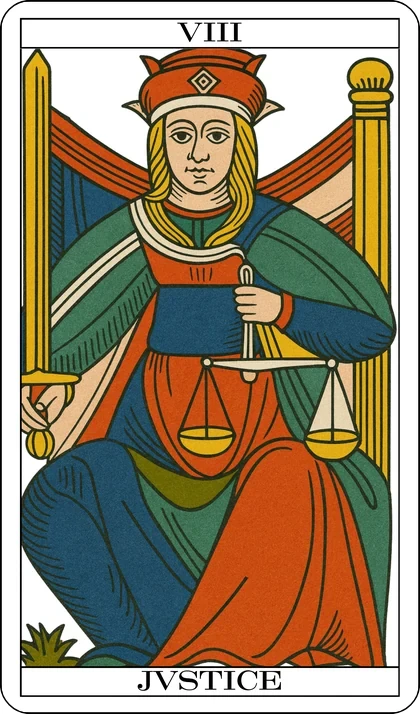
The planche shows a crowned figure seated facing forward on a high-backed chair. In one hand the figure holds an upright sword; in the other, a balance with two pans. The numeral VIII appears in additive form. These are the only elements drawn: no landscape, no secondary figure, no architectural detail beyond the chair.
Ce que dit la lame
At its core, La Justice signifies the law of causality. Every action provokes a reaction; no energy is lost; every effort is paid and every wrong is settled. This is not a human court with a calendar. It is an order that knows no limit of space or time.
The two objects on the planche make this visible. The balance shows two things weighed against each other, not to find a comfortable middle but to expose an exact correspondence. The upright sword shows a cut that separates what is due from what is not. Together they point to a settling of accounts that cannot be negotiated away.
La Justice does not describe a mood or a wish. It describes a structure. In the presence of La Justice, the question is not whether an account will be settled, but whether the person is ready to see the settlement for what it is.
À l’endroit
Upright, La Justice carries the axis of equity obtained. The strongest meaning is a favorable outcome in legal or administrative matters: a case won, a file approved, a right recognized. Next comes the officializing of a situation, whether affective or professional: a marriage, a contract, a status made formal. The person feels heard; what was floating becomes fixed. Balance and harmony follow, and the overall assessment is positive.
À l’envers
Reversed, La Justice does not mean the absence of fairness. It carries its own axis: iniquity suffered. The strongest meaning is a problem in legal or administrative matters: a case lost, a file blocked, a tax dispute. The person may face a ruling that feels one-sided or a procedure that drags on without resolution. From this comes a feeling of injustice, an imbalance between what was given and what was received. Excess and excessiveness enter: too much pressure, too much demand, a situation out of proportion. Disturbances follow.
Separate from this main axis, the reversed orientation can also point to nervous tension, anxiety, or insomnia. These are accessory meanings, not the core of the card, and they do not turn the reversed La Justice into a medical statement.
Ce qui nuance cette lecture
A single card never makes a spread. La Justice does not set a deadline; only a position in a spread can indicate timing. If La Justice appears in a position about the past, it may describe a settled account; in a future position, a balance still to be struck. The surrounding cards color the field: with a card of material structure, the legal or administrative side may dominate; with a card of relationship, the officializing of a bond may come forward. The question asked also narrows the meaning: a question about work will read the upright sense through contracts and recognition; a question about inner life will read balance and harmony. No card, including La Justice, predicts a fixed event by itself.
Questions fréquentes
Does La Justice always announce a court case?
No. It can point to legal or administrative matters, but its core is causal order, balance, and the settling of accounts. A court case is only one possible field.
Is the reversed La Justice simply the opposite of the upright?
No. In the Marseille Tarot, the two orientations carry independent meanings. Upright points to equity obtained; reversed points to iniquity suffered, with its own shades of excess, imbalance, and disturbance.
Why is La Justice numbered VIII and not XI?
In the Marseille Tarot, La Justice is the eighth major arcanum and Strength is the eleventh. Some later decks swap them, but the Marseille planche keeps the numeral VIII in additive form.
Does La Justice predict a specific time frame?
No. A card is timeless. Only its position in a spread, such as past, present, or future, can suggest a time frame. La Justice itself speaks of an order that has no spatial or temporal limit.